

Hongbao
Plasma welding technology empowers the manufacturing of high-voltage wiring harnesses for new energy vehicles, ensuring high efficiency, reliability, and durability
Published Time:
2026-03-16 16:37
As the "neural network" for power transmission, the manufacturing quality of high-voltage wiring harnesses for energy vehicles directly affects the safety and reliability of the entire vehicle. Traditional welding techniques are gradually showing limitations in meeting the high voltage, high current, and lightweight requirements of high-voltage wire harnesses for new energy vehicles. However, plasma welding technology for wire harnesses, with its advantages of high energy density, precise control, and strong material adaptability, is becoming the core force driving the upgrading of high-voltage wire harness manufacturing.
The working voltage of the high-voltage system of new energy vehicles generally reaches 400V to 800V, and some high-performance models even exceed 1000V, while carrying hundreds of amperes of continuous current. This high voltage and high current environment imposes strict requirements on the welding quality of wire harnesses: on the one hand, welding joints need to have extremely low resistance to reduce energy loss and avoid safety hazards caused by local overheating; On the other hand, the welding process needs to avoid defects such as porosity and cracks to ensure the reliability of long-term service. In addition, with the widespread application of aluminum wires in high-voltage wire harnesses, how to solve the electrochemical corrosion problem of copper aluminum dissimilar metal welding has become a technical bottleneck that urgently needs to be overcome in the industry.
Although traditional welding techniques such as ultrasonic welding and friction welding can achieve copper aluminum connections, they have limitations such as high equipment costs and poor process stability. For example, ultrasonic welding has insufficient seismic resistance and is prone to loose connections during vehicle vibration during driving; The specialized equipment for friction welding requires a large investment, and the welding quality is significantly affected by the operating environment. These pain points have prompted the industry to seek more efficient and reliable welding solutions.
Plasma welding technology achieves energy concentration output through highly compressed plasma arc, and its core advantages perfectly meet the manufacturing needs of high-voltage wire harnesses for new energy vehicles
1. High energy density and precise control
The temperature of plasma arc can reach over 24000 ℃, and the energy density is more than 10 times that of traditional tungsten inert gas arc welding. This characteristic enables it to quickly melt metal and form a deep and narrow melt pool, achieving single-sided welding and double-sided forming. For example, in the welding of 8mm thick stainless steel plates, plasma welding can penetrate in one go without the need for chamfering, and the welding efficiency is more than three times higher than traditional processes. For the common copper aluminum dissimilar metal connections in high-voltage wire harnesses, the high temperature of plasma arc can damage the oxide layer on the metal surface, and at the same time, metallurgical bonding can be formed by adding solder, significantly reducing contact resistance and suppressing electrochemical corrosion.
2. Material adaptability and process flexibility
Plasma welding supports multiple working gas combinations, such as a mixed gas of 95% argon and 5% hydrogen, which can optimize weld formation and reduce porosity defects. Its current regulation range is wide (0.1A to several hundred amperes), which can weld ultra-thin foil materials of 0.1mm and process thick plate materials. In the manufacturing of high-voltage wiring harnesses, this characteristic makes it flexible to be applied in complex scenarios such as welding wires and connectors, shielding layer treatment, etc. For example, in the welding of aluminum foil shielding layer, plasma arc can achieve 360 ° low impedance connection, ensuring electromagnetic shielding effect.
3. Quality stability and production efficiency
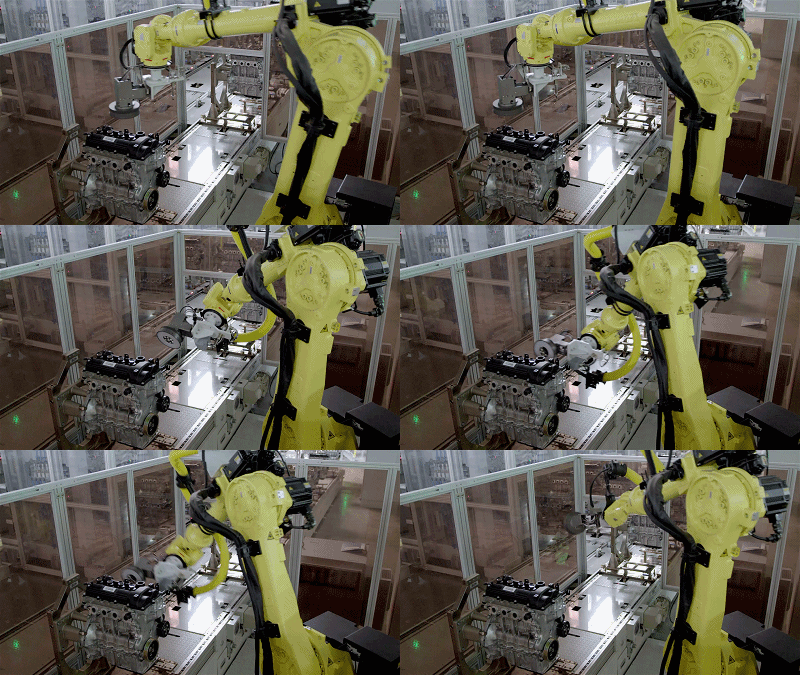
Plasma arc has better stability than traditional arc, lower sensitivity to arc length fluctuations, less spatter and deformation during welding. On the automated production line, plasma welding equipment can be integrated with robots to achieve 24-hour continuous operation, with a stable product qualification rate of over 99.5%. After a certain new energy vehicle enterprise adopted plasma welding technology, the production cycle of high-voltage wire harnesses was shortened by 40%, the repair rate was reduced by 60%, and the comprehensive cost was reduced by 25%.
The application of plasma welding technology in the field of new energy vehicles has made substantial breakthroughs. In the manufacturing of ultra-low temperature pressure vessels, the plasma arc+wire argon arc (PAW+GTAW) combined welding technology has achieved one-time welding forming. This technology has been applied to the manufacturing of high-pressure hydrogen fuel cell hydrogen storage tanks, significantly improving production efficiency and product lightweighting level. In the welding of nickel based alloy pipelines, by optimizing the ion gas flow rate and welding speed parameters, the problem of weld solidification cracks has been successfully solved, providing key support for the durability design of high-voltage wire harnesses.
In addition, the integration of plasma welding and intelligent sensing technology is driving the digital upgrade of manufacturing processes. By real-time monitoring of welding current, voltage, arc length and other parameters, combined with AI algorithms to construct a quality prediction model, potential defects can be identified in advance, achieving a transition from "post detection" to "process control". After a certain enterprise introduced the system, the welding defect rate of high-voltage wire harnesses decreased from 0.8% to 0.05%, reaching the international leading level.
As new energy vehicles evolve towards 800V high-voltage platforms, solid-state batteries, and other directions, the manufacturing demand for high-voltage wiring harnesses will continue to upgrade. Plasma welding technology needs to deepen innovation in the following dimensions:
Material adaptability: Develop specialized welding processes for high thermal conductivity materials (such as silicon carbon composite materials) to meet the manufacturing needs of next-generation battery pack wiring harnesses.
Process integration: Explore the integration of plasma welding with laser cleaning, online detection and other processes, and build an integrated production line of "welding detection repair".
Green Manufacturing: Optimizing the energy efficiency of plasma generators, reducing the consumption of inert gases, and promoting the low-carbon transformation of welding processes.
Plasma welding technology is reshaping the manufacturing paradigm of high-voltage wiring harnesses for new energy vehicles with the core values of "efficiency, reliability, and durability". From laboratory innovation to industrial implementation, from breakthroughs in single processes to system solutions, this technological wave not only injects growth momentum into the industry, but also provides hardcore support for the "Chinese solution" of global energy transformation.
Plasma welding technology