

Hongbao
Breaking through the boundaries of standardization: How non-standard automation precisely addresses pain points in production
Published Time:
2026-02-26 16:22
Amidst the wave of transformation and upgrading in the manufacturing industry, standardized equipment once served as the "master key" for enterprises to enhance efficiency. However, with the diversification of consumer demands and accelerated product iteration, the limitations of traditional assembly lines have become increasingly prominent - single functionality cannot adapt to multi-variety production, rigid structures struggle to cope with process changes, and universal designs fail to meet the needs of segmented scenarios. Against this backdrop, non-standard automation, with its core concept of "tailored customization," has emerged as a pivotal force in addressing production pain points.
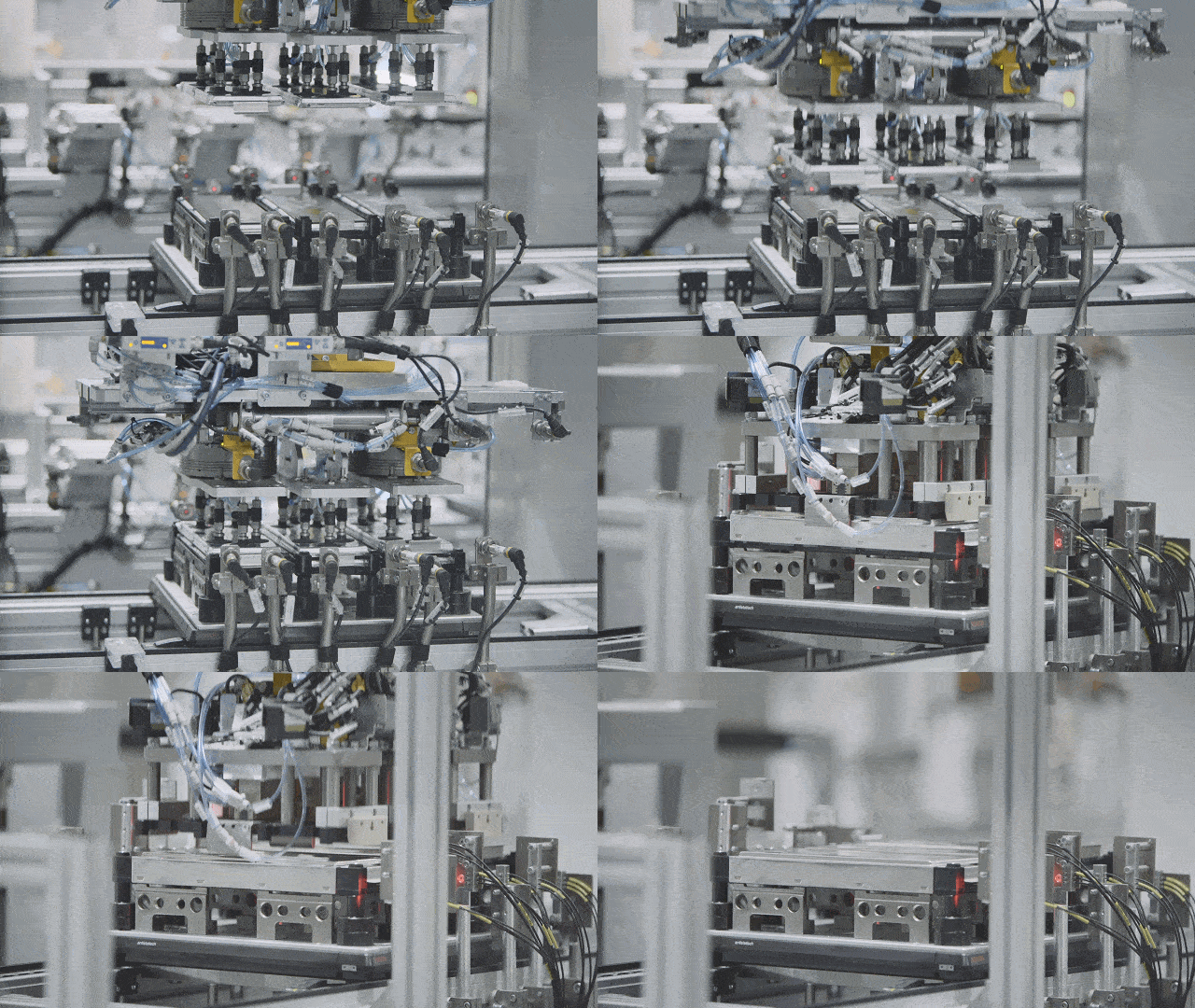
1. Flexible production: Solving the challenge of mixed production lines for multiple varieties
The automotive industry is a typical production scenario characterized by "multiple varieties and small batches." After launching new energy vehicle models, a medium-sized automaker needed to achieve mixed-model production of fuel vehicles and new energy vehicles on the same production line, involving differentiated assembly of more than 10 types of components. Due to fixed equipment and rigid processes in traditional production lines, switching between models required a 2-hour downtime for adjustment, and assembly errors resulted in 35% of products needing rework. The non-standard automation team designed a modular flexible assembly line for it, which achieved automatic process switching through a PLC control system. Coupled with a visual inspection system, the assembly accuracy was improved to 0.01mm. With the modular design, adding new models only required updating programs and adding modules. After the transformation, the production line changeover time was shortened to 15 minutes, mixed-model production efficiency increased by 40%, and the defect rate decreased by 35%. This successfully achieved flexible production of "eight models on the same production line.".
This flexibility is also reflected in the field of electronic manufacturing. A consumer electronics company faced the challenge of mounting micro earphone components: the component size is only 2mm, and traditional equipment suffers from a 5% defect rate due to insufficient precision. The non-standard automation solution utilizes imported servo motors and ball screw drives to stabilize the repeatability positioning accuracy to ±0.02mm; customized vacuum suction nozzles and fixtures achieve "zero-damage adsorption"; and an integrated visual inspection system screens solder joints for microcracks in real time, reducing the defect rate to 0.3%. After the transformation, the company's micro earphone mounting efficiency increased by 200%, the order delivery cycle was shortened by 40%, and it successfully seized the high-end market.
II. High-precision control: Breaking through technological limits
In the aerospace industry, non-standard automation has become a core tool for achieving "millimeter-level precision". In the manufacturing of engine blades for an aviation company, traditional processes suffer from manual operation errors, resulting in a processing accuracy of only ±0.1mm and a production cycle lasting up to 30 days. The explosion-proof assembly line developed by the non-standard automation team achieves "damage-free docking" through a 6-axis robot and pressure sensors in a fully enclosed inert gas environment, elevating the processing accuracy to ±0.03mm. The detection system based on CT scanning can identify internal defects at the 0.1mm level, resulting in an eightfold increase in efficiency. After the transformation, the blade manufacturing cycle has been shortened by 50%, and the processing quality of complex surfaces has reached the international advanced level.
The medical industry has stricter requirements for clean production. In the intravenous drug dispensing process of a pharmaceutical company, traditional manual operations pose a risk of cross-contamination, and microbial testing takes 48 hours. The introduction of a non-standard automation solution, featuring an intelligent dispensing robot, enables the mixing of 20 types of drug solutions within 30 seconds through a robotic arm and sensors. The customized testing line integrates spectral analysis and AI algorithms, reducing the microbial testing time to 6 hours and achieving FDA certification in one attempt. This transformation not only ensures medication safety but also enables the company to undertake international orders.
III. Full-process closed loop: Reconstructing efficiency in traditional industries
The food industry's demand for automation equipment meets dual standards of efficiency and safety. A snack food company once experienced a 10% product return rate due to weight discrepancies caused by manual measurement errors, and the packaging line's efficiency was only 300 units per hour, resulting in a capacity gap of 40% during peak seasons. The non-standard automation team designed a fully automated packaging line that adopts 304 stainless steel and food-grade silicone materials, meeting the GB 4806 food safety standards. It integrates high-precision weighing sensors (with an error margin of ±1g), an automatic feeding system, and an anti-jamming device, achieving full automation of the "weighing-sealing-printing-packaging" process. After the transformation, the packaging line's efficiency increased to 1200 units per hour, with a weighing accuracy rate of 100%. Additionally, due to reduced manual contact, the product hygiene inspection pass rate increased to 99.9%.
The intelligent upgrade of the logistics industry also relies on non-standard automation. During the "Singles' Day" shopping festival, an e-commerce warehouse needs to handle a sorting task of 500,000 orders per day. The traditional "human-to-goods" model results in labor costs accounting for up to 70% of the total. The non-standard automation solution introduces AGV robots and intelligent warehousing systems, achieving "goods-to-human" sorting through laser navigation and path optimization algorithms. This reduces labor demand in a single warehouse by 60% and increases sorting efficiency by three times. The -30°C low-temperature stacker developed for cold chain scenarios has reduced the manual intervention rate in cold storage from 70% to 10%, effectively solving the problem of high equipment failure rates in low-temperature environments.
Driven by the "dual carbon" goals, non-standard equipment is achieving energy conservation and emission reduction through optimizing energy management and reducing material loss. For example, a photovoltaic enterprise has transformed its silicon wafer cutting line through non-standard automation, adopting a closed-loop water circulation system to reduce water resource consumption, and dynamically adjusting cutting parameters with intelligent algorithms, resulting in a 12% increase in silicon material utilization. The annual electricity savings of a single line are equivalent to reducing carbon emissions by 300 tons. At the same time, the modular design concept endows non-standard equipment with the characteristics of "dismantlability and upgradeability", extending the equipment's life cycle and reducing carbon emissions throughout its entire life cycle.
In addition, the integration of non-standard automation and circular economy models is giving rise to new business forms. A certain waste home appliance dismantling enterprise has achieved automatic classification and recycling of over 95% of materials through customized robots, with an annual processing capacity exceeding 500,000 units, driving a 40% increase in resource regeneration efficiency. With continuous breakthroughs in materials science, energy technology, and digital technology, non-standard automation will transcend the traditional single value dimension of "cost reduction and efficiency improvement", playing an irreplaceable role in building a resource-saving and environmentally friendly industrial system, injecting green momentum into the high-quality development of the manufacturing industry.
In the future, non-standard automation will not only need to strengthen its own technological accumulation, but also build an open ecosystem, collaborate with upstream and downstream enterprises and scientific research institutions for innovation, and jointly explore new paradigms of flexible manufacturing and green manufacturing. It can be predicted that on the path of addressing production pain points and reshaping industrial competitiveness, non-standard automation will play an increasingly crucial role and become an "invisible engine" driving the high-quality development of the manufacturing industry.