

Hongbao
Unveiling the core value of non-standard automation equipment from "adaptation" to "empowerment"
Published Time:
2025-12-22 16:42
With "tailor-made" as the core, non-standard automation equipment deeply integrates enterprise production needs, not only solving the pain points of personalized manufacturing, but also unleashing huge potential in efficiency, cost, and innovation capabilities. Behind this transformation, it reflects the urgent demand for flexible and intelligent production in the manufacturing industry, and also reveals the value transition of non-standard equipment from "tools" to "strategic assets".
The breakthrough of the manufacturing industry in the "standardization dilemma" is that traditional production models cannot meet the diversified production needs of enterprises. Therefore, the application of non-standard automatic automation equipment has emerged. The emergence of non-standard equipment, through modular design and customized development, accurately matches the production process of enterprises, shortens the equipment transformation cycle to a few days, and even achieves "production and adjustment at the same time". This "on-demand adaptation" capability makes non-standard equipment a "buffer" for enterprises to cope with market fluctuations, providing basic support for personalized manufacturing.
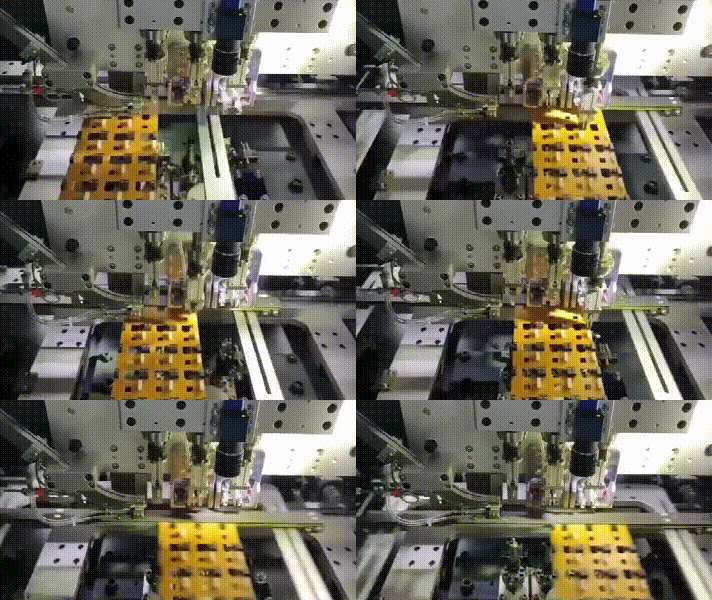
Non standard equipment breaks the inherent logic of "equipment determines process". Taking the automotive parts industry as an example, traditional stamping equipment is limited by mold size and can only produce products of fixed specifications; The non-standard stamping line integrates intelligent sensors and flexible fixtures to automatically adjust stamping parameters, achieving compatibility with multiple types of parts on the same production line. This reverse innovation of "process adaptation equipment" not only reduces the investment cost of enterprise equipment, but also promotes the standardization and lean production process. Data shows that enterprises that introduce non-standard equipment have a 30% reduction in average production cycle, a 25% increase in comprehensive equipment utilization rate, and significant direct economic benefits.
When non-standard equipment moves from "adaptive production" to "empowering production", its value dimension undergoes a qualitative change. At this stage, the equipment is no longer limited to solving efficiency problems in a single link, but becomes the "nerve center" of enterprise digital transformation through data-driven and intelligent integration. For example, a certain household appliance enterprise has achieved full process automation from part loading to finished product production by deploying non-standard assembly lines and deeply integrating visual inspection, robot collaboration, and MES systems. More importantly, the real-time operation data of the equipment is uploaded to the cloud, and the production parameters are analyzed and optimized through AI algorithms, reducing the product defect rate from 1.2% to 0.3% and saving over 10 million yuan in quality costs annually. This ability of "self perception, self decision-making, and self optimization" marks the upgrade of non-standard devices from "execution tools" to "intelligent partners".
The core value of non-standard equipment will ultimately be reflected in the restructuring of the manufacturing ecosystem. With the popularization of 5G, industrial Internet and digital twin technology, non-standard equipment is evolving from "stand-alone intelligence" to "system intelligence". In the future, seamless integration between devices and between devices and systems will be achieved, forming a full chain intelligent network covering design, production, and logistics. For example, a certain photovoltaic enterprise deployed a non-standard automated production line, combined with digital twin technology, to simulate the production process in a virtual environment, detect and solve potential problems in advance, and shorten the production cycle of the new production line by 70%. This "rehearsal style production" model will completely change the pain points of traditional manufacturing industry, such as high trial and error costs and long iteration cycles.
The more profound impact is that the popularization of non-standard equipment will promote the transformation of the manufacturing industry towards "service-oriented manufacturing". When the equipment has data collection and analysis capabilities, suppliers can provide value-added services such as predictive maintenance and capacity optimization based on operational data, forming a dual revenue model of "equipment sales+operational services". It is predicted that by 2025, the global non-standard automation equipment service market will exceed 100 billion US dollars, accounting for over 40% of the total market. Under this trend, non-standard equipment is no longer just a production tool, but has become a "value hub" connecting manufacturing and services, hardware and software.
The core value of non-standard automation equipment is being redefined from "adaptation" to "empowerment". It is not only a "solver" for enterprises to meet personalized needs, but also an "engine" to promote the transformation of manufacturing towards intelligence and service. In the future industrial competition, enterprises that master the ability to customize non-standard equipment will be more likely to establish competitive advantages in segmented fields, and the entire manufacturing ecosystem will also radiate stronger vitality due to this "tailor-made" wisdom.